
Longtime diplomatic observers feel that if Narendra Modi were to become prime minister or even a Cabinet official if the BJP captures power in the next election, there is no way the State Department would refuse him entry into the US, unless Washington wanted to risk the unravelling of the carefully nurtured US-India strategic partnership. Rediff.com's Aziz Haniffa reports from Washington, DC.

Once Mazar-i-Sharif falls, some isolate pockets of resistance may remain, which the Taliban would tackle through political work or coercion, asserts Ambassador M K Bhadrakumar.
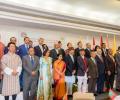
Connectivity is what SAARC needs the most but Pakistan is not interested, says Rajeev Sharma.

New Delhi must indicate to Afghan President Ashraf Ghani that it has a long-term strategy for his country. It should point out that Pakistan's present Afgan policy will destabilise Afghanistan and help Islamic State, says Gautam Sen.

It seems China is ready to cooperate with India in the central Asian region through the SCO framework, the reasons for which are manifold, says Sana Hashmi.

'I am hopeful that you will see more focused attention on this relationship,' former US assistant secretary of state Nisha Desai Biswal tells Alokananda Chakraborty.
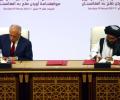
'Pakistan's trump card is that it is the only credible guarantor on the horizon who can reasonably assure the Western world that Afghanistan will not again become the revolving door for international terrorism.' 'Trust Pakistan to play this card optimally,' explains Ambassador M K Bhadrakumar.

'It's unclear whether she is the target of the investigation, or what agents were searching for. The officials said it is an ongoing investigation and no charges have been filed,' reports CNN.com, while the Post adds that "the exact nature of the investigation involving Raphel remains unclear. She has not been charged.'

She also addressed the Indian Community at a reception held in her honour in Jakarta.

China said that decision is in line with the rules of the committee.
He did not mention the issue of Jammu and Kashmir.

Access to Sabang Port will allow the Indian Navy to dominate Malacca Strait more effectively, reports Ajai Shukla.
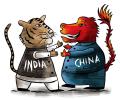
India and China achieved a major milestone this year when their bilateral trade crossed the landmark figure of $100 billion but it did not generate any fanfare in both capitals as the two Asian giants are going through a "particularly bad patch" in their relations due to a set of actions by Beijing in violation of agreements that led to the military standoff in eastern Ladakh. Starting with a modest $1.83 billion in 2001, the bilateral trade crossed $100 billion-mark in the first 11 months this year, a significant milestone for which the two countries carried out campaigns to boost trade and build it as a major stakeholder to improve the relations between two nations, whose ties otherwise remained frosty over the festering boundary dispute and strategic rivalry. According to last month's data from China's General Administration of Customs (GAC), the India-China bilateral trade totalled $114.263 billion, up 46.4 per cent year-on-year from January to November 2021.
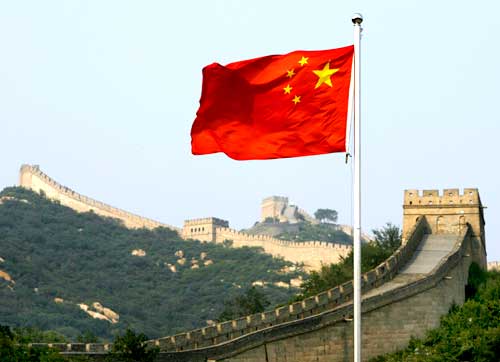
China chose a sports contest to announce the change of the name of Taiwan, a self-governed cash-rich island.

'There was never really a doubt, but now it can be conclusively stated that the prime minister has unusual mental and physical stamina,' says Sheela Bhatt/Rediff.com who is covering Narendra Modi's visit to the United States.

The Trump regime has informed the Congress that it 'strongly supports' transfers of F-18 and F-16 fighter proposals put forth by Boeing and Lockheed Martin respectively.
India has experienced hands and will emerge with flying colours, declares Inspector General Gurdip Singh Uban (retd).

Aziz Haniffa reports from Washignton, DC, on Foreign Secretary Sujatha Singh's three-day visit to the US capital.

'From the very start, PM Modi was insistent that visiting foreign leaders should be exposed to an India beyond its capital.' 'Through these experiences, he felt that the full Indian narrative would be much better understood across the world,' explains External Affairs Minister S Jaishankar. A riveting excerpt from Bluekraft Digital Foundation's Modi@20: Dreams Meet Delivery.

India has been eyeing deeper energy ties with Iran and has already lined up $20 billion as investment in oil and gas as well as in petrochemical and fertiliser sectors there.
The prime minister also welcomed convergence of views between India and ASEAN for cooperation in the Indo-Pacific region.
'Russian diplomacy is presumably at work.' 'The ground is slippery, because "territorial sovereignty" is a hugely sensitive issue,' says Ambassador M K Bhadrakumar.

The US has the distinction of destroying a flawed but functioning State thrice since 1979. Pakistan has been their constant accomplice, explains Shekhar Gupta.

China's behaviour in the post-pandemic geopolitical landscape which may determine the Quad's future trajectory, notes former foreign secretary Shyam Saran.

Iran's decision to keep India out and welcome China to the scene is a huge strategic setback for India, observes Dr Rajaram Panda.
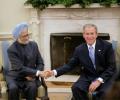
'The nuclear deal required Prime Minister Manmohan Singh to gamble the future of his government on a vision for the future of his nation.'

Was the Modi-Obama summit the panacea for all that troubles the India-US relationship?

United States recognises that the Indian electorate has weighed in with a resounding mandate for Narendra Modi, and we want to work with the prime minister-designate on advancing his goals for India as a regional and global player, says Gujarat-born US State Department official Nisha Desai Biswal.

Prime Minister Narendra Modi on Wednesday held bilateral talks with all Heads of Government and State attending the 18th SAARC Summit in Kathmandu with Pakistan Prime Minister Nawaz Sharif the only conspicuous exemption.
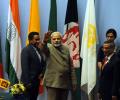
'If his three priorities are the economy, the economy, the economy, then there is need for a stable region, a stable neighbourhood.'

'The worst case scenario for Pakistan is a full-scale Taliban takeover of Afghanistan.' 'Pakistani militants would be inspired and emboldened and seek to replicate the Taliban's successes in Pakistan.'
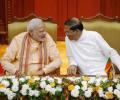
'What we have heard from the Sri Lankans is their desire to have a foreign policy that allows Sri Lanka to best advance its own interests rather than a foreign policy that relied solely on one relationship.' 'We think this is an attitude that makes a lot of sense. India and Sri Lanka have many areas of shared interests, and it's certainly welcomed by us to see that deepening of those ties.'

'It is absolutely important for us to continue to message to people that they must wear masks, keep physical distancing, as much as is practically possible, at work or at home.'

The prime minister will have a tight schedule in the Philippines as besides attending the 15th ASEAN-India summit and 12th East Asia summit on November 14, he will have a series of other engagements including bilateral meetings with several leaders.

Just like China wants Trump to lose the US presidential poll, it may want Modi to lose the Lok Sabha polls. So months before the 2024 elections, China may take possession of an important area, say one of the Char Dhams, warns Sanjeev Nayyar.

'Even as discord over US-India trade and commerce colours diplomatic relations, defence relations between the two countries remain on a firm footing,' points out Ajai Shukla.
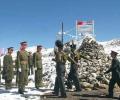
Suddenly the sands are shifting and even friends are acting strange.
'The world does not care about the tension on our border.' 'India has to emerge as a strong economic power.' 'Respect comes when the world sees a country with a direction and leadership that has a vision,' points out Ramesh Menon.
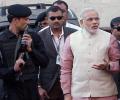
The people in charge of the PM's security need to shift the emphasis from the numerical (the number of policemen deployed) to technology-based solutions to sanitise the area where he resides, works and during his road journeys, says Anil Chowdhry, former secretary (internal security), ministry of home affairs.
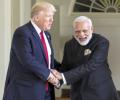
'The Modi government would chaff at the very idea of holding talks with Pakistan, facilitated by Washington and under close US monitoring, when the 2019 poll is sailing into view.' 'But in politics and diplomacy, there may be moments when drinking from the chalice of poison is necessary,' says Ambassador M K Bhadrakumar.
